


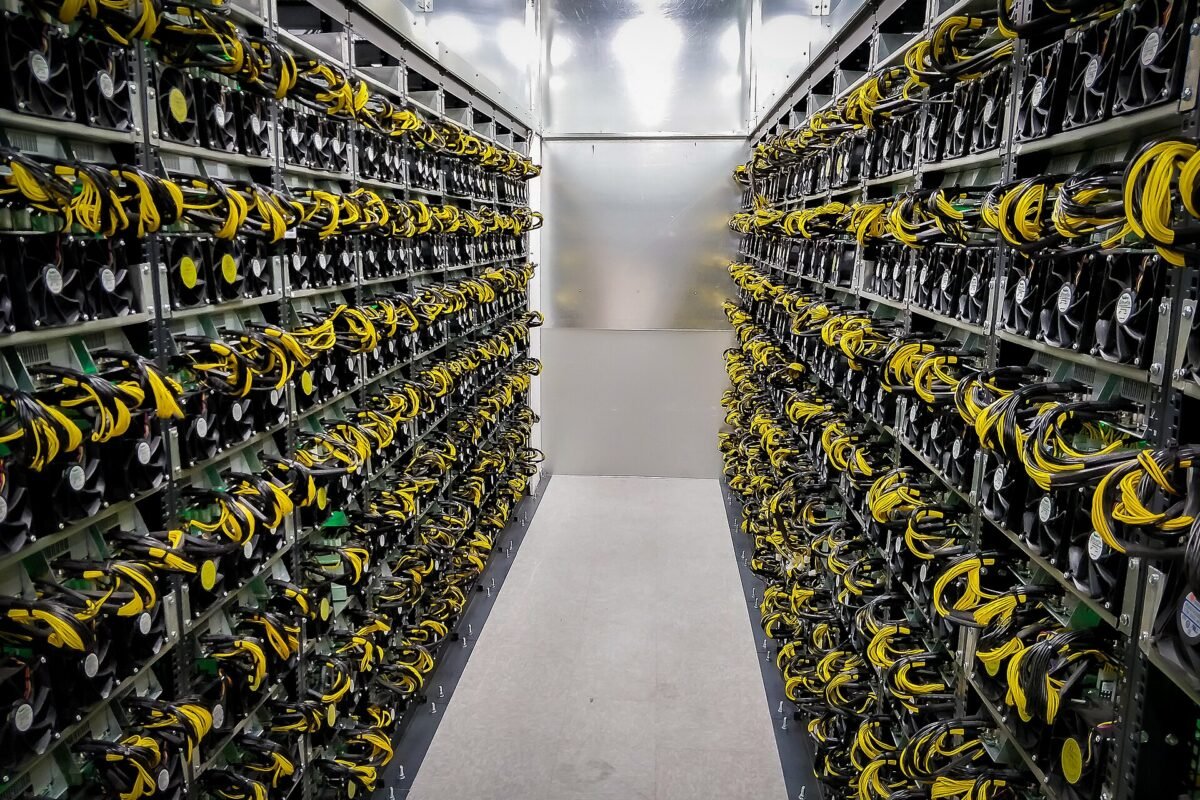
Anyone asking what is bitcoin halving is asking about a built-in rule that cuts the reward for mining new bitcoin blocks in half roughly every four years, or every 210,000 blocks. It slows the creation of new bitcoin and is why total supply will never exceed 21 million coins. The most recent halving, in April 2024, cut the block reward from 6.25 to 3.125 bitcoin; the next is expected around 2028.
Most money gets created at someone’s discretion. The Federal Reserve decides interest rates; governments decide how much to borrow. Bitcoin went the other way: its issuance schedule was written into the code in 2009, and every four years the flow of new coins drops by half, no committee required.
That schedule has become one of the most-watched events in crypto, and the source of the “four-year cycle” theory. With bitcoin trading around $77,000 to $78,000 in early November 2026, down from its highs and shaken by the $6.3 billion Binance hack, it’s worth asking how much the halving actually explains.
Key takeaways
- Bitcoin halvings happen every 210,000 blocks, about every four years, and cut new supply in half.
- The April 2024 halving reduced the block reward to 3.125 BTC; the next will cut it to about 1.5625 BTC.
- More than 19.9 million of the 21 million bitcoins already exist, so each halving matters less to total supply.
- Miners’ revenue drops sharply at each halving, pushing out less efficient operators.
- Past halvings preceded big rallies, but with only four data points and new forces like ETFs, the pattern is far from a law.
What is bitcoin halving and how does it work?
Bitcoin halving is the scheduled 50% reduction in the number of new bitcoins awarded to miners for each block they add to the blockchain. It’s enforced by the software every node runs, so it can’t be skipped or delayed without a change that the network would have to adopt.
Miners compete to add a new block about every 10 minutes. The winner earns a block subsidy (new bitcoins) plus the transaction fees users paid. When bitcoin launched, the subsidy was 50 BTC per block. It has halved four times since:
| Halving | Approximate date | Block height | Reward after halving |
|---|---|---|---|
| Launch | January 2009 | 0 | 50 BTC |
| First | November 2012 | 210,000 | 25 BTC |
| Second | July 2016 | 420,000 | 12.5 BTC |
| Third | May 2020 | 630,000 | 6.25 BTC |
| Fourth | April 2024 | 840,000 | 3.125 BTC |
| Fifth (expected) | Around 2028 | 1,050,000 | 1.5625 BTC |
Because blocks don’t arrive at exactly 10-minute intervals, the halving date is estimated from the block height, not set on a calendar.
Why does bitcoin have a 21 million supply cap?
The cap is a mathematical result of the halving schedule. Add up 210,000 blocks times 50, then times 25, then 12.5, and so on, and the series converges just under 21 million. Satoshi Nakamoto, bitcoin’s pseudonymous creator, described the system in the original bitcoin white paper and chose a fixed, declining issuance to mimic a scarce commodity like gold.
The last fraction of a bitcoin is expected to be mined around the year 2140. After that, miners will earn only transaction fees. Lost coins, whether from forgotten passwords or discarded hard drives, mean the effective circulating supply is lower than the headline number.
For a broader look at how bitcoin’s design differs from Ethereum’s, see Ethereum vs Bitcoin.
How does halving affect bitcoin miners?
Overnight, every miner’s subsidy income in bitcoin terms is cut in half while electricity and equipment costs stay the same. Unless bitcoin’s price or transaction fees rise enough to compensate, margins get squeezed.
The results tend to follow a pattern:
- Weaker miners shut off older, less efficient machines or sell out.
- Consolidation: larger public miners with cheap power and newer hardware gain share.
- Diversification: after the 2024 halving, several publicly listed miners redirected power and data center capacity toward AI and high-performance computing customers. Our explainer on AI data centers and energy covers why their power contracts became so valuable.
- Difficulty adjusts: if miners drop off, the network automatically lowers mining difficulty about every two weeks so blocks keep arriving roughly every 10 minutes.
The long-term question is security. As subsidies shrink, transaction fees need to carry more of the load to keep miners incentivized. That debate will intensify with each halving.
Does the bitcoin halving cycle predict prices?
This is where most of the hype lives. Each previous halving was followed, within roughly 12 to 18 months, by a large bull market and then a deep drawdown. The theory is simple: if demand holds steady while new supply drops, price should rise.
We’d treat it with skepticism for a few reasons:
- Tiny sample. Four halvings are not a statistically meaningful dataset.
- Shrinking impact. The 2024 halving cut new supply by roughly 450 BTC a day, a much smaller share of total supply than early halvings did.
- Bigger forces now. Spot bitcoin ETFs, which launched in the U.S. in January 2024, can absorb or release far more than daily miner issuance. Our guide to bitcoin ETFs explains how those flows work.
- Macro matters. Interest rates, liquidity and risk appetite now move bitcoin alongside tech stocks. With the Fed expected to hike in December and the Nasdaq in correction, macro is doing a lot of the steering.
- It’s known in advance. Everyone can see the halving coming years ahead, which should make at least part of its effect priced in.
That doesn’t mean supply doesn’t matter. It means it’s one input among many, not a calendar you can trade on.
What does halving mean for bitcoin investors?
- Don’t buy because of a halving countdown. Buy, if you buy at all, because of your long-term thesis and risk tolerance.
- Size your position so a 50% drawdown wouldn’t force you to sell. Bitcoin has had several.
- Consider steady buying. Dollar-cost averaging removes the temptation to time cycles.
- Secure your holdings with a reputable custodian or your own hardware wallet, especially after this year’s exchange hack.
- Watch out for halving-themed scams. Fake “halving bonus” giveaways and mining investment schemes spike around these events.
The SEC’s Investor.gov has investor alerts on crypto asset risks worth reading before you put money in.
Our take: halving is about supply, not a price guarantee
The halving is a genuinely elegant piece of monetary design, and the predictable, shrinking supply is a core part of bitcoin’s appeal as “digital scarcity.” But the idea that it guarantees a rally 18 months later relies on a handful of data points from a much smaller, less institutional market.
The next halving is still more than a year away. If you’re investing in bitcoin, focus on what you control: position size, cost, custody and holding period. If someone pitches you a trade based purely on the halving calendar, assume they’re selling something.
Frequently asked questions
When is the next bitcoin halving?
It’s expected around 2028, at block 1,050,000. The exact date depends on how quickly blocks are mined between now and then, so estimates shift slightly over time.
What happens when all 21 million bitcoins are mined?
Miners will earn only transaction fees instead of new coins. That’s expected around 2140. Whether fees alone will be enough to secure the network is an open question.
Does halving make bitcoin more valuable?
It reduces the rate of new supply, which can support prices if demand holds or grows. But demand, macro conditions and investor sentiment matter at least as much, and halving effects are widely anticipated.
Do other cryptocurrencies have halvings?
Some do. Litecoin and Bitcoin Cash, for example, use similar halving schedules. Ethereum doesn’t; its issuance depends on staking rules and a fee-burning mechanism instead.
This article is for educational purposes only and is not financial advice. Consider speaking with a licensed professional before making investment decisions.



Community Insights
0 Comments